6,400
Bytes Send
Viasat IoT Nano is a highly cost-effective way of sending and receiving small amounts of IoT data; ideal for fixed IoT applications such as Mining, Oil & Gas, Utilities, Renewables, Agriculture, and Environmental Monitoring.
It’s unaffected by weather conditions, and IoT Nano terminals draw very little power, running on battery power for several years. IoT Nano is a low latency (15-60 seconds) service with almost global coverage; only the polar regions are not served.
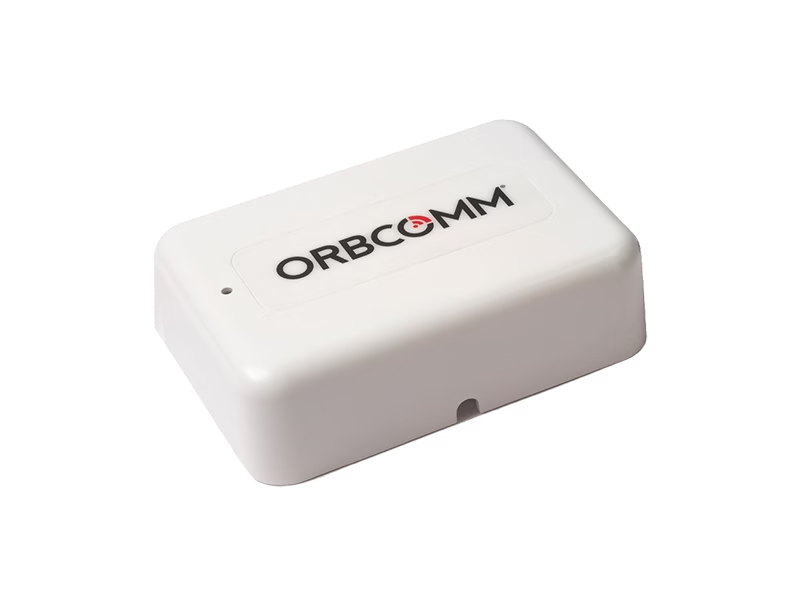
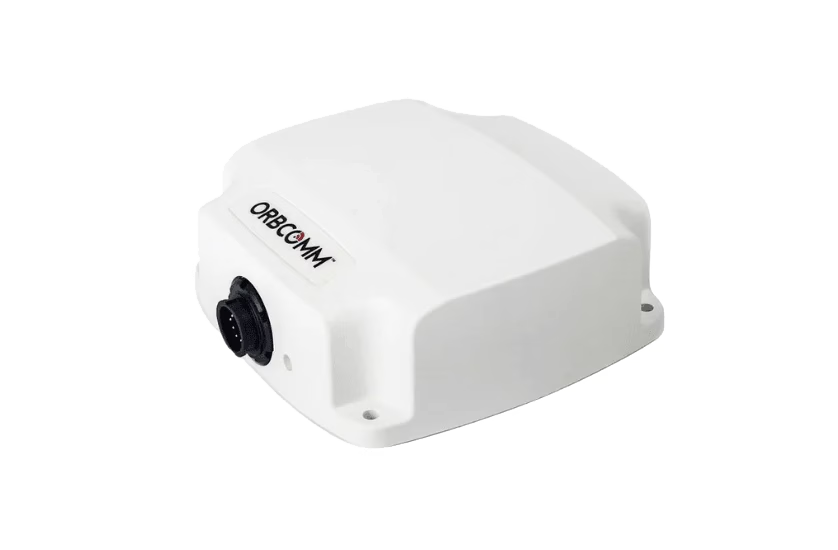
Ground Control partners with trusted third parties on IoT Nano terminals, and we particularly like these Orbcomm options for their design, features and price point.
The simple and effective ST 2100 connects to your gateway or sensor via a serial port, and delivers plug-and-play connectivity with its simple AT command set.
The ST 6100 is fully programmable and comes with resources to support integration into diverse custom solutions. It also has super low power consumption, fully capable of operating on a battery / solar power.
6,400
Bytes Send
10,000
Bytes Receive
15-60
Seconds Latency*
*Depending on message size
Viasat’s satellites are positioned in geostationary orbit. At 35,786 Km up, they move at the same speed as the Earth rotates, so appear stationary to us – hence the name! At this distance, they can ‘see’ a lot of the Earth’s surface, so a small number of satellites are needed to provide close to global coverage. IoT Nano currently operates on six L-band satellites, which deliver coverage everywhere with the exception of the polar regions.
There are several benefits of GEO satellites. Once you’re connected to the satellite, if your asset isn’t moving around, the connection will be extremely stable. If it *is* moving around, you will need an auto-pointing or omni-directional antenna that can adjust to your asset’s position relative to the satellite. The devices we’ve featured on this page have omni-directional antennae built in.
GEO services tend to be lower cost than comparative LEO (Low Earth Orbit) satellite airtime plans, so it’s often a very cost-effective option.
Viasat Coverage Map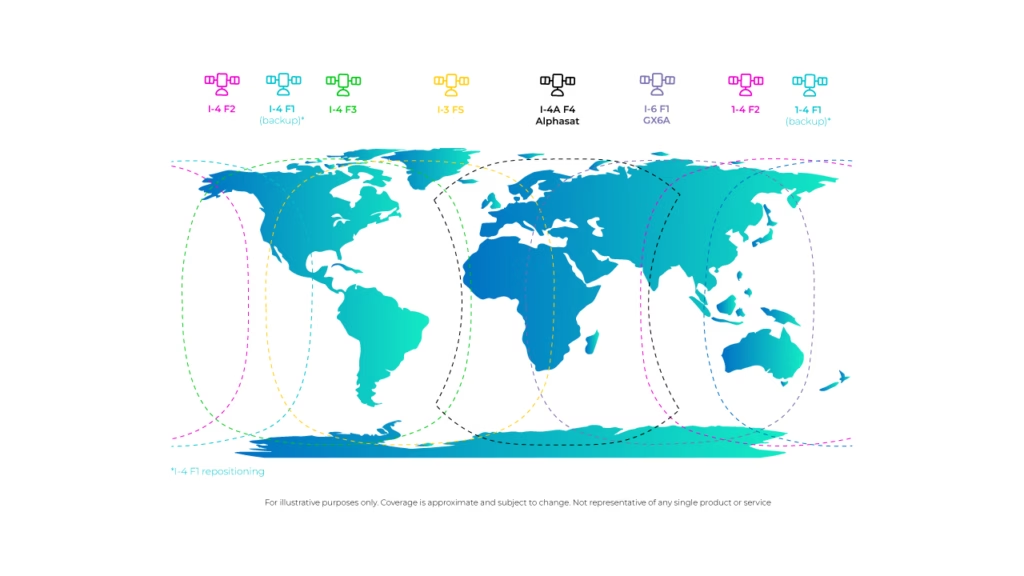
IoT Nano is a message-based airtime service, which is a very cost-effective way of using the space segment. Utilizing the tried and trusted Viasat satellite network, it’s secure, reliable, and scalable.
Talk to our team if you’d like some advice on whether IoT Nano is the best satellite airtime service for your requirements; we have 20 years’ experience in satellite IoT, and we’re here to help..
Viasat IoT Nano utilizes the L-band radio frequency, which is licensed (so you don’t have to worry about congestion slowing down transmissions), & unaffected by weather conditions.
IoT Nano ensures predictable data usage with minimal overhead, pooling data within each rate plan to avoid unexpected costs. There’s great flexibility for IoT solutions, scaling from initial pilots to large deployments.
As a message-based service, IoT Nano is event-driven, which means it’s not only low cost (sending only what you need, when you need it), it also draws much less power than ‘always on’ solutions.
Latency – the time it takes for the message to leave the terminal and travel via the satellite to your server – is just 15-60 seconds with IoT Nano – depending on the message size. This is very fast for a GEO satellite network!
Viasat’s satellite network covers most of the planet, with only the polar regions excluded. This means you can access the service without roaming charges, as long as you have line of sight to a satellite.
It’s tricky to compare airtime services because so much depends on how much data you need to send, but as a rough guide, we’ve put together the following comparison points. Get in touch if you’d like any help deciding what will work best for you.
| Service | Viasat IoT Nano | Iridium SBD | Iridium Certus 100 | Viasat IoT Pro |
|---|---|---|---|---|
| Connection Type: | Message-based | Message-Based | IP-based | IP-based |
| Typical Connection Speed: | 6.4 / 10 kB per Message | 270 / 320 B per Message | 22 / 88 Kbps | 448 / 464 Kbps |
| Satellite Orbit: | Geo-stationary (GEO) | Low Earth Orbit (LEO) | Low Earth Orbit (LEO) | Geo-stationary (GEO) |
| Latency: | Low | Very Low | Very Low | Low |
| Total Cost of Ownership: | Lowest | Very Low | Medium | Low |
| Power Usage: | Very Low | Very Low | Low | Low |
| Connection Frequency: | On Demand | On Demand | Frequently Connected | Frequently Connected |
| Great For: | Small amounts of data from individual sensors | Very small amounts of data from individual sensors | Fixed or mobile IoT applications which require IP connection | Fixed IoT applications with larger amounts of data to transfer via an IP connection |
If you’re developing a remote IoT application and need to explore your connectivity options, Ground Control can help. We design and build our own satellite IoT hardware and services platform, Cloudloop, and work with trusted third parties when they have a great product, like the Orbcomm devices we’ve featured on this page.
We can offer you expert, impartial advice on the best satellite network and device for your requirements. Just complete the form or email hello@groundcontrol.com, and we’ll come back to you within one working day.